Daily currency exchange rates from central banks, for a hotel lobby, an airport hall, or a bureau window.
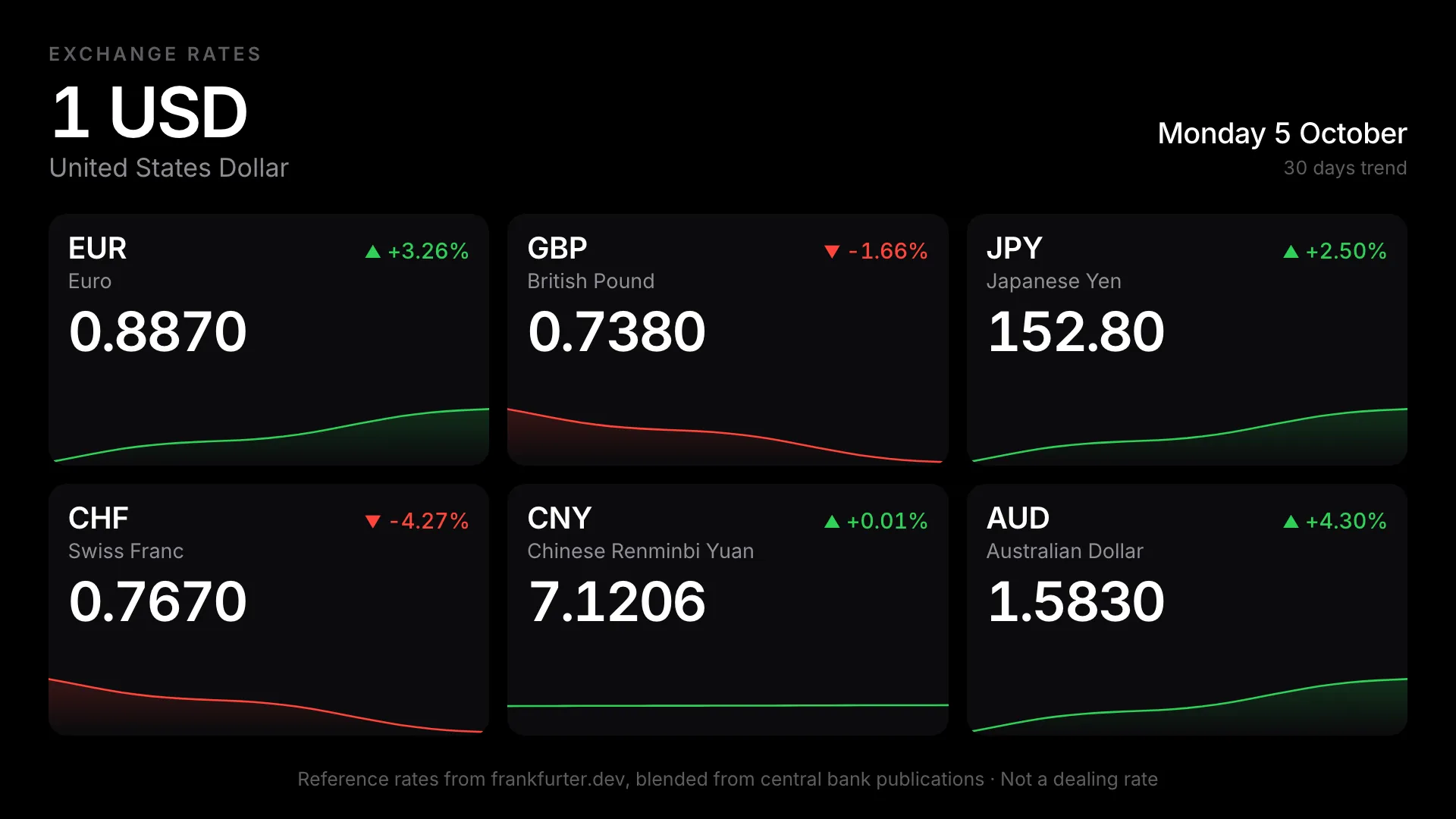
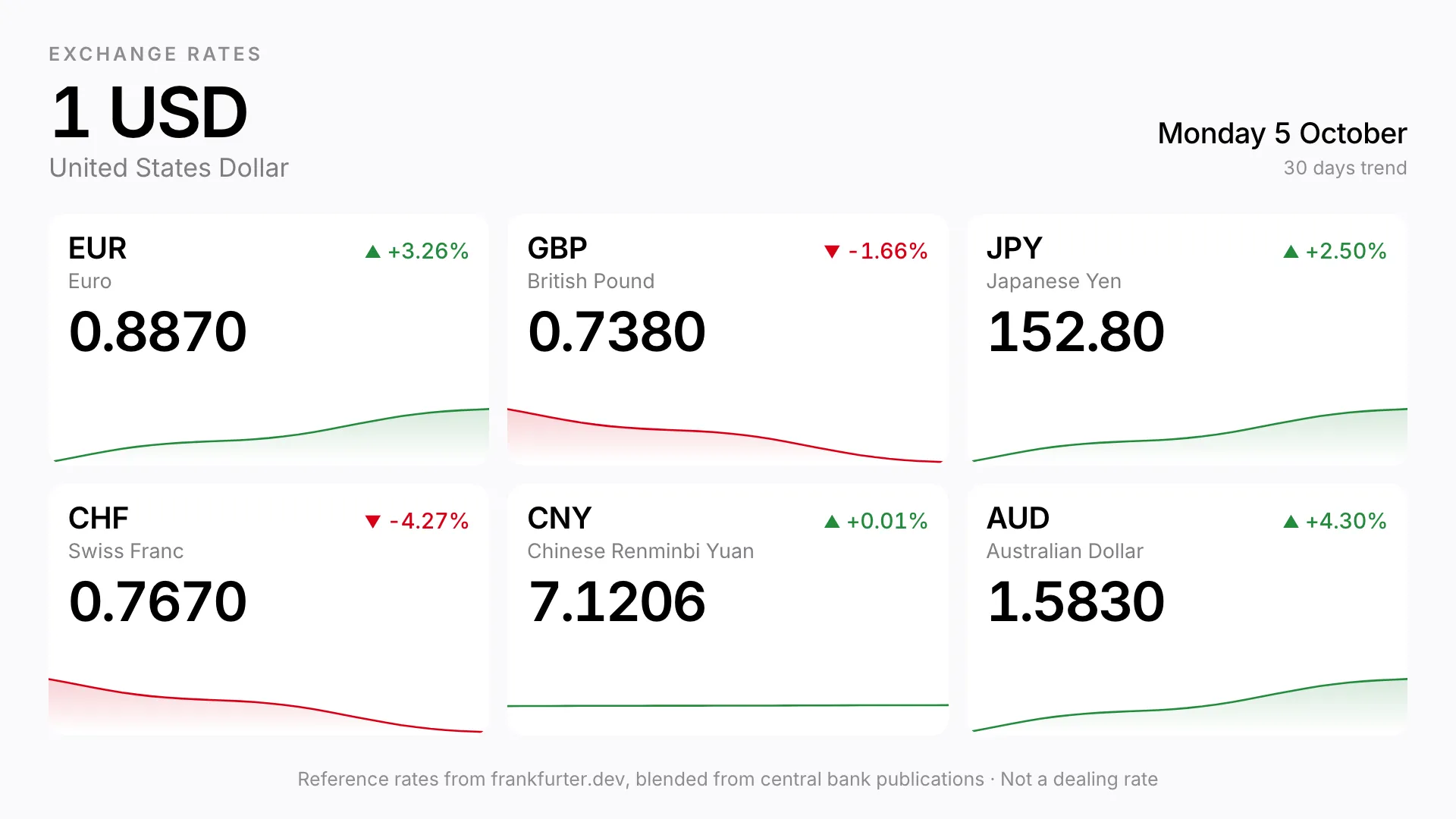
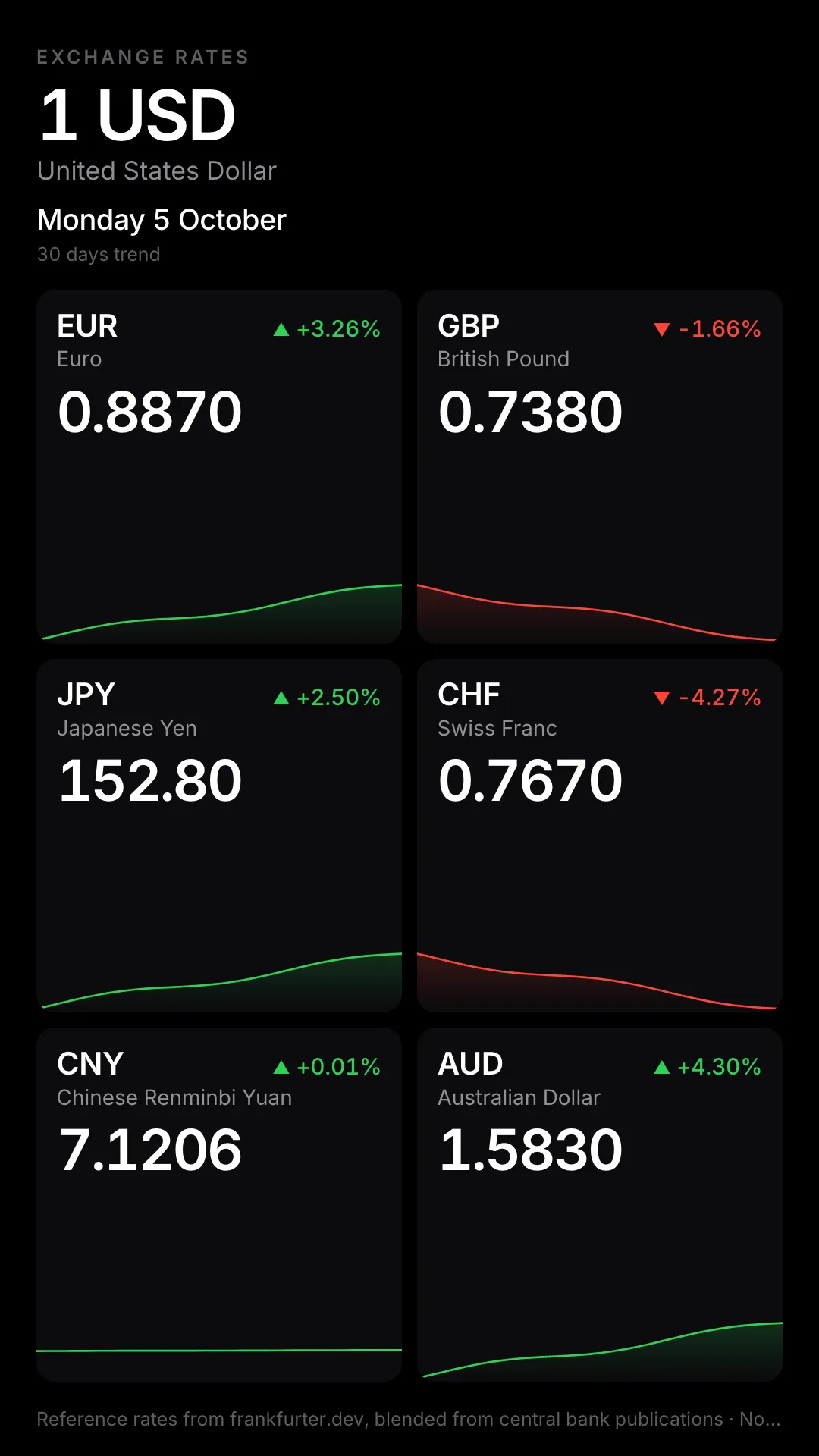
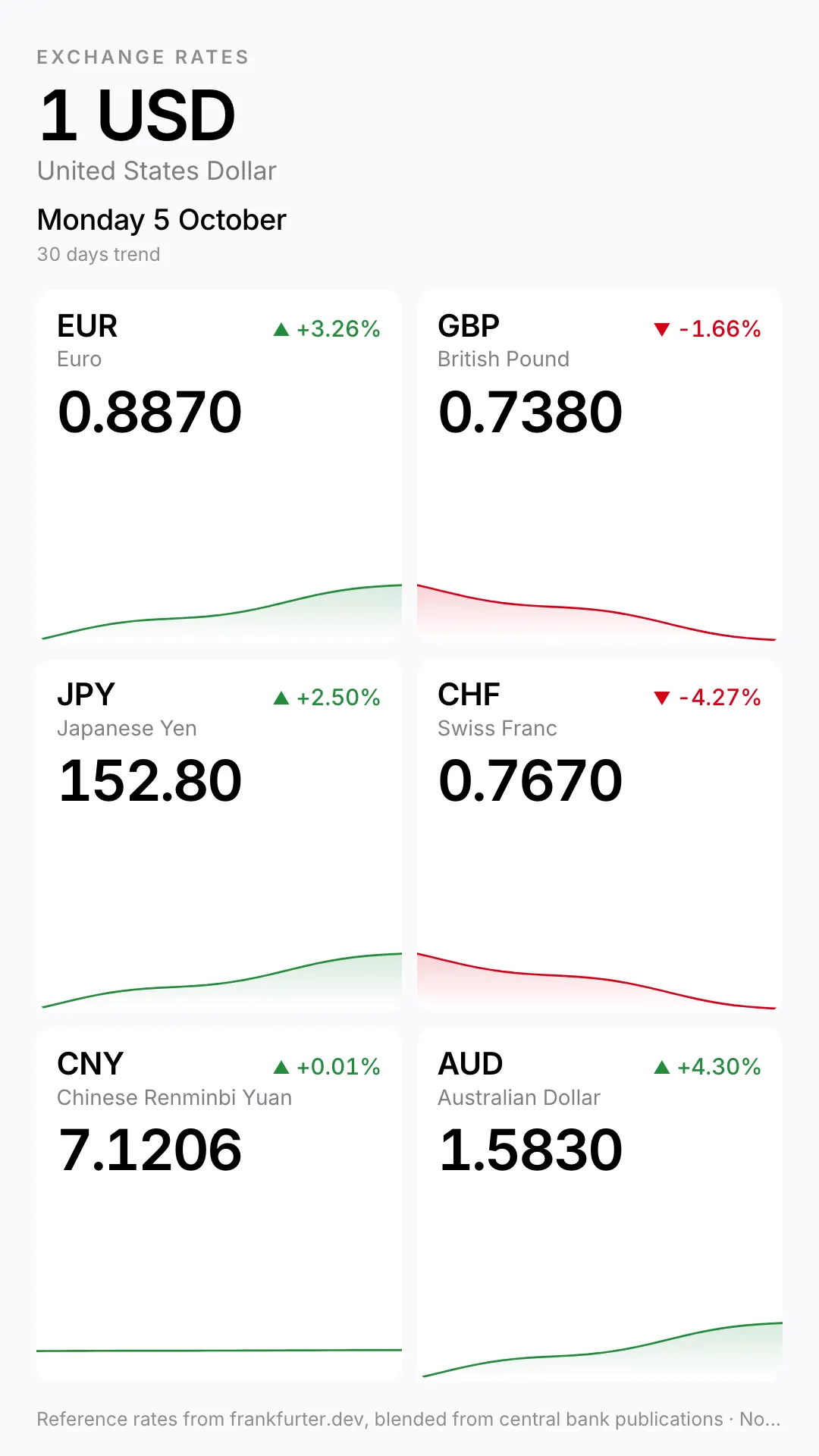
One base currency sits across the top, with a card for each currency priced against it. Each card carries the rate, how far it has moved, and a line showing that movement. The rates come from central banks, once a working day, with no API key and no account.
What it shows
The masthead names what everything is priced against, such as “1 USD”, along with the currency’s full name and the day the rates were published. A bureau quoting a weak base can set the amount to 100 or 1000 instead, and every figure follows.
Each card shows one currency: its code, its name, the rate, and the change across the chosen time window. Green means up and red means down, in colours that stay readable in both the dark and light themes.
The trend line runs the full width of each card and uses the same window for every card. A currency that barely moved is drawn as one, so a quiet month never looks like a big swing. Pegged currencies get a flat line without a filled area underneath.
If one currency’s source has not published as recently as the rest, its card shows the day it last did, so a stale figure is never passed off as today’s.
Which way round the board reads
The same rates can be shown two ways with the Rate Direction setting:
- buys: a hotel in Frankfurt quoting its guests’ currencies shows “100 USD” across the top, and each card is what those dollars are worth
- costs: a bureau in Tokyo shows “JPY” across the top, and each card is what one unit of that currency costs in yen, which is how a counter quotes it
The trend lines and colours flip to match, so the yen gaining is the dollar costing less.
Any currency, any screen
Any of the 165 currencies Frankfurter quotes can be the base or appear on the board, up to twelve at a time. Type the three-letter codes in any case, separated by commas, spaces, or new lines. Anything that is not a valid code is named at the foot of the board rather than silently ignored.
The board measures the room it has and picks its grid from that, so the same settings fill a landscape screen four across and a portrait screen two across.
Why use Exchange Rates?
Ideal for hotel receptions, airports, currency exchange counters, banks, travel agencies, and international offices: anywhere people need a quick, trustworthy view of today’s rates.
Key features
- 165 currencies from the European Central Bank and around a hundred other central banks and official institutions
- No API key or account needed
- Trend line over 7 days, 30 days, 90 days, or a year
- buys or costs reading, to match how your counter quotes
- Dark and light themes
- Fits any screen shape, landscape or portrait
- Keeps working offline by showing the last rates it received
Configuration settings
| Setting | Description | Default |
|---|---|---|
| Base Currency | What the rates are priced against, as a three-letter code | USD |
| Rate Direction | buys, or costs for the other way round | buys |
| Quote Currencies | Which currencies to show, in the order they should appear | EUR,GBP,JPY,CHF,CNY,AUD |
| Amount | Units each rate is for: of the base, or of each card’s currency | 1 |
| Trend Days | How far back the line goes: 7, 30, 90 days, or a year | 30 |
| Theme | dark or light | dark |
| On Error | show what went wrong, or skip and let the screen move on | show |
| Board Title | The line above the base currency | Exchange rates |
When the rates cannot be reached
A screen that has shown the board before keeps showing it, with the day it received those rates in the masthead, so a dropped connection costs nothing.
On Error covers a screen with nothing cached yet, usually one that started up during an outage. show puts the problem on screen, which helps while setting the app up. skip hands the screen to whatever else is scheduled, which suits a lobby. Either way, the app keeps retrying and draws the board as soon as it can.
Attribution
Rates come from Frankfurter, which collects the reference rates published by the European Central Bank and other central banks and official institutions. These are reference rates published once a working day, not dealing rates.