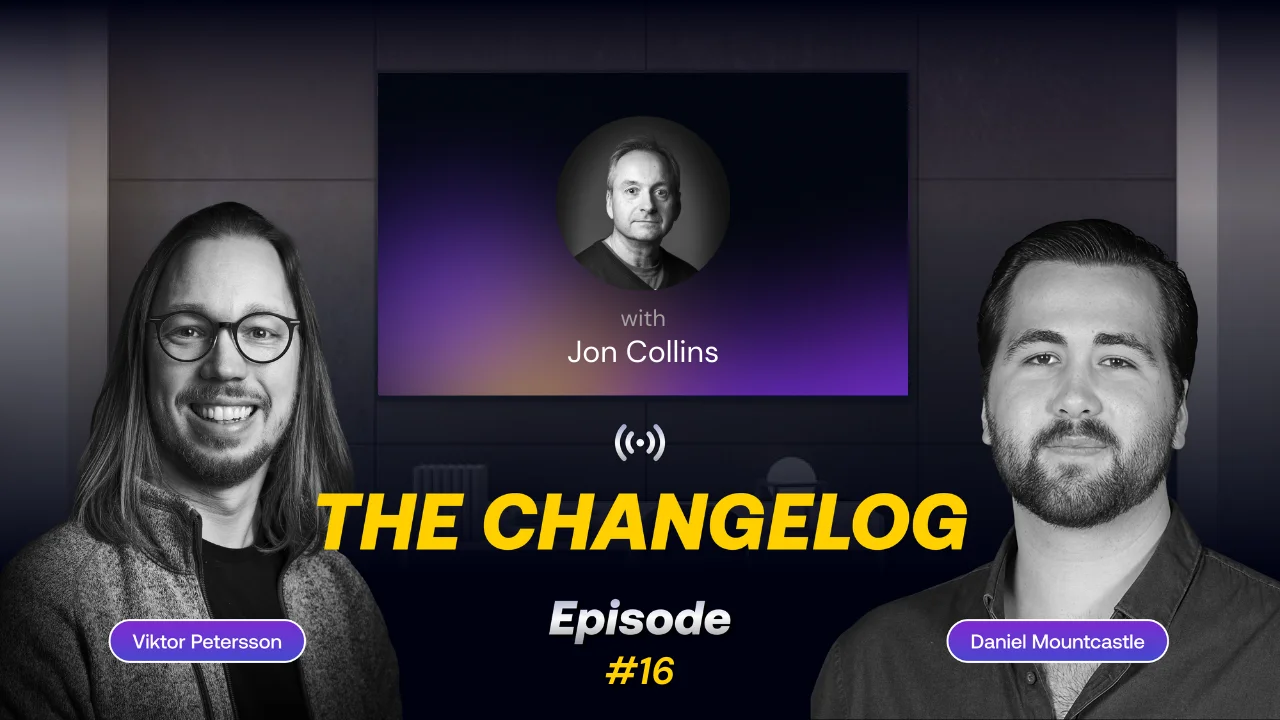
Screenly Changelog Episode 16: Screenly Changelog Episode 16 - Why Signage Is Becoming Enterprise Infrastructure With Jon Collins of GigaOm
Digital signage has a funny way of sitting at the edge of everything while still being at the center of what people experience. In this conversation, Viktor Petersson and Daniel Mountcastle sit down with Jon Collins, VP of Engagement at GigaOm, to unpack what enterprise IT is starting to see in signage, and why the next phase of our industry is going to be shaped by ownership, adaptability, and real security culture.
If you have ever wondered why a display can be both “just a screen” and a serious part of your infrastructure, this one is for you. Watch the full conversation above or read the highlights below.
Signage is not the endpoint, it is the moment that matters
Jon frames signage in a way that instantly makes it bigger than hardware. A screen is not the final stop of a system. It is a stage in how information moves through a business or a customer journey. What matters is whether the right person sees the right thing at the right time, and whether that moment helps them do what comes next. That is why signage can never be treated like a passive output. It is a live part of the process, even if it sits physically at the edge of the network.
For us, this explains a lot about why deployments succeed or stall. When teams understand signage as a decision point, not a decoration, they start asking better questions: what data should be shown? Who needs it? How often does it change? What happens if it is wrong or delayed? Those questions pull signage into the same strategic space as any other business system.
The collision of AV, IT, and building ops is already here
Viktor brings up a shift we have all been watching. AV used to be isolated. Now everything is network connected, and IT is walking in the door asking about ownership, lifecycle, and security. Jon expands that into a broader collision between AV, IT, OT, and building management. The tech is converging, but the people and budgets often are not.
Jon’s point lands hard because it is so familiar. The teams who understand the technology do not always want to coordinate, and the layer above them that controls budgets often does not fully grasp what is being bought. So you end up with systems that are critical, visible, and expensive, but still treated like side projects. This is exactly why we see signage growing into cross functional territory. It needs shared responsibility, not a silo.
Digital sovereignty is really about being a responsible adult
The conversation starts with recent cloud outages as context, but quickly turns into something bigger. When Viktor asks Jon about digital sovereignty, Jon reframes it away from buzzwords. Sovereignty is not only about where data lives, but it is also about control, choice, and accountability. If you depend on infrastructure you do not understand, you can lose access to things that matter for no good reason. That realization is pushing organizations to rethink what belongs in the cloud, what should be local, and how much choice they want back.
Jon calls this “adulting” at cloud scale, and we loved that phrasing because it is honest. Nobody is coming to magically remove complexity for you. The only sustainable answer is to own your architecture decisions, even if someone else runs the servers. This shows up in signage too. If displays are part of critical communication, then uptime, data routing, and regional control are not optional details. They are the work.
Security is a culture, not a paper exercise
A big thread in this conversation is how security in signage is changing, especially with new regulations on the horizon. Viktor shares a DEF CON example where a signage player was compromised, then used as a stepping stone into cloud infrastructure and the wider network. The risk is rarely just vandalizing a screen. The risk is lateral movement through a device that was treated as harmless.
Later, they talked about the EU Cyber Resilience Act and why much of the industry is not ready. The key takeaway is not fear but clarity. Compliance frameworks can be met on paper without building a real security process. What matters is whether security is baked into how products are built and maintained over time. When organizations internalize that, regulation becomes a competitive edge rather than a scramble.
That aligns with how we think about Secure by Default. You do not bolt security on after deployment. You build systems that assume they will be part of a network, part of a workflow, and part of someone’s risk surface.
Flexibility wins when use cases keep evolving
Daniel and Jon also talk about a trap the industry still falls into. Single use signage solutions can look neat, but they also box customers into someone else’s assumptions. Real deployments change after six weeks, not six years, once teams see what the screen is capable of and what they actually need. Flexibility up front saves money now, and creates agility later.
This is where we connect the conversation to why we built Screenly Edge Apps. Viktor explains them as a runtime environment on the device, designed because we cannot predict every way you will want to use signage. Some teams want to pull data from an ERP system, others want a dashboard that fits their own internal workflows. Edge Apps are our way of letting you build for your context, not ours.
The theme here is humility. The best platforms do not assume the future, they make room for it.
What we are taking forward
There is a real shift happening in signage. Screens are moving from the edges of IT conversations to the middle of them, which means decisions about ownership, security, and flexibility matter more than ever.
The good news is that the path forward is clear. Build systems that can evolve with real use cases, take security seriously from day one, and make them simple enough that teams actually enjoy using them. When those pieces are in place, signage becomes a reliable part of how work gets done.
If this sparked any ideas, the full conversation is live. We hope it helps you see your own screens a little differently, whether you are scaling a fleet or rethinking your first deployment.
Watch the full conversation with Viktor, Daniel, and Jon in The Screenly Changelog. Learn how digital signage is evolving into real enterprise infrastructure, and what it takes to build systems that stay secure, flexible, and reliable over time.
Learn more and get started with Screenly
Interested in secure, scalable digital signage solutions? Explore Screenly and start your 14-day free trial today.
Stay tuned for future updates, and thank you for joining us for The Screenly Changelog.