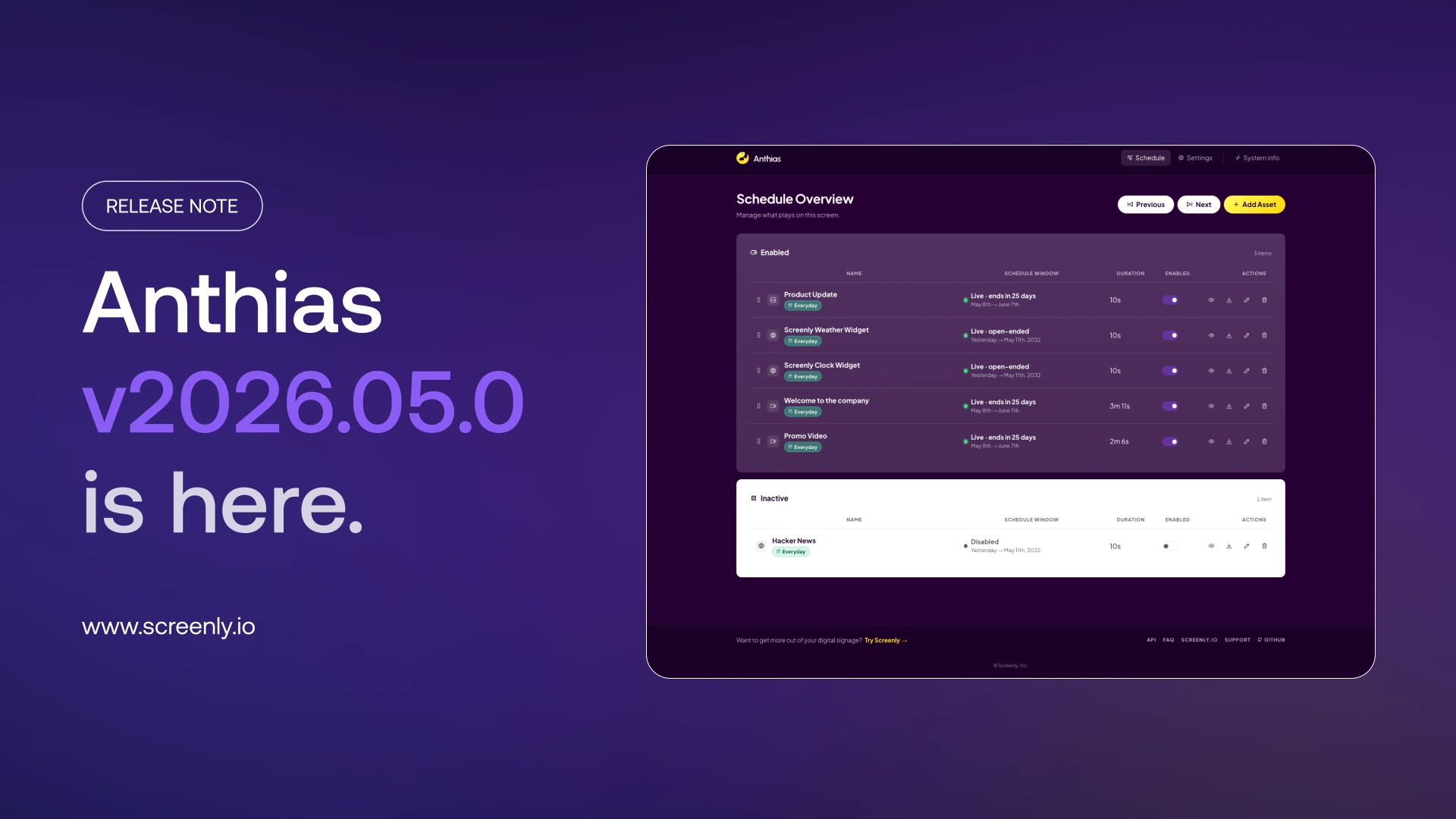

After months of work, we’re thrilled to ship Anthias v2026.05.0, a landmark update that touches nearly every part of the project. Whether you’re running a single display in a coffee shop or a fleet of Pi-powered screens across a campus, this release brings meaningful improvements to reliability, performance, and day-to-day usability.
Here’s what’s new.
Schedule your content, your way
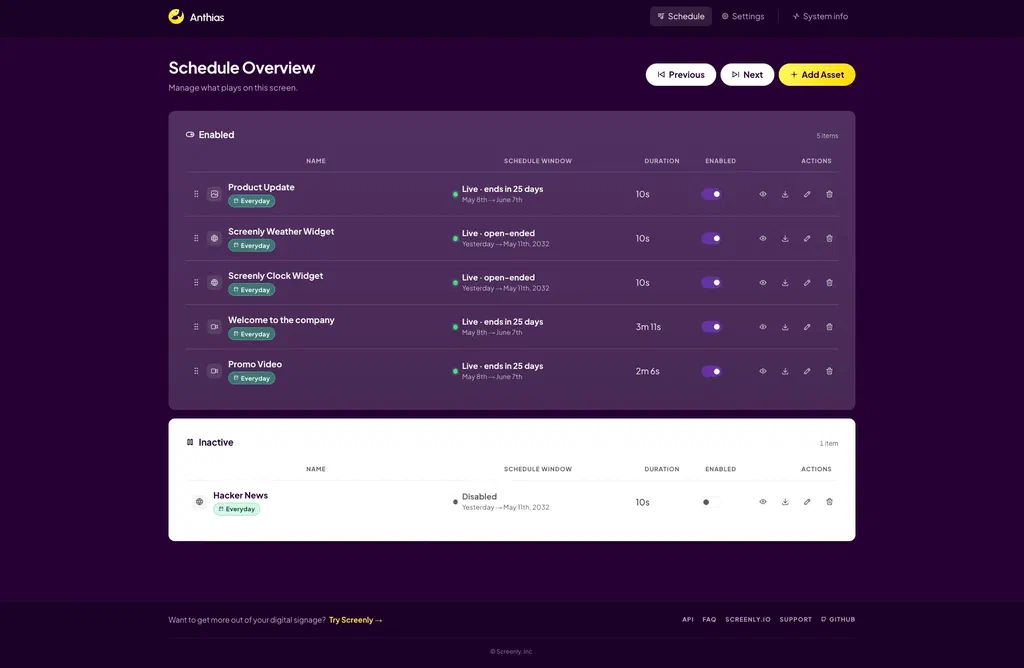
The most-requested feature on the Anthias forum is finally here: per-asset scheduling. You can now set each piece of content to display only on specific days of the week and times of day. Morning announcements, weekend promotions, and after-hours messaging all just work without needing workarounds or external tools.
On a similar note, web page assets can now auto-refresh on a custom interval, so live dashboards and data displays always show fresh information without any manual intervention.
Raspberry Pi 4 (64-bit) and Pi 5: first-class citizens
If you’ve been holding off on upgrading your hardware, now’s the time. We’ve done a significant amount of work to bring rock-solid hardware-accelerated video playback to the Raspberry Pi 4 (64-bit) and Pi 5. The viewer now uses the correct decoder for these boards, putting an end to the crash loops, frame drops, and playback failures that have frustrated early adopters. Audio output settings are also properly respected now, so there are no more audio routing surprises.
A modern foundation
Under the hood, this release is a major modernisation.
Debian Trixie + Python 3.13
All Docker images are now built on the latest stable Debian release, and the Python runtime has been bumped to 3.13. You get a faster, more secure base to build on.
Django 5.2 LTS
The web framework has been upgraded to the latest long-term support release, bringing two more years of security coverage.
React is out; HTMX + Alpine.js are in
We’ve replaced the React single-page application with a lighter, server-rendered approach. The result is a smaller JavaScript footprint, no React build pipeline to maintain, and a snappier UI, especially on lower-powered hardware.
Simpler architecture, smaller footprint
We’ve taken the opportunity to streamline how Anthias runs internally:
- ZMQ is gone. Internal messaging now runs over Redis, which was already a requirement, so there’s one fewer dependency to ship and maintain.
- Two containers became one. The separate nginx and WebSocket containers have been merged into a single server, making deployments simpler and reducing memory overhead.
- Celery no longer needs its own Docker image. It now shares the web server image, saving around 825 MB of SD card storage per device. That’s a meaningful saving on a 32 GB card.
- Docker images are significantly smaller. Unused dependencies, unnecessary packages, and the wifi-connect service have all been stripped out.
- We’ve modernised the toolchain. Python dependencies are now managed with uv, and JavaScript builds run through Bun, replacing the previous mix of pip, npm, and webpack. Faster builds, cleaner dependency management.
Fixes you’ll actually notice
Beyond the big architectural changes, we’ve shipped a pile of fixes for issues that have been bothering the community:
- Log files no longer fill up your SD card. One user reported a 19 GB log file from a long-running device. Container logs now route to the system journal, which handles rotation automatically.
- The black screen between assets is noticeably shorter. Media is now pre-parsed in the background, reducing the gap when switching from one asset to the next.
- The next/previous skip buttons work correctly again.
- The dashboard is now properly usable on phones and small tablets.
- YouTube downloads no longer time out.
- Long asset names are truncated gracefully with a tooltip showing the full name on hover.
- HEIC, HEIF, TIFF, and other unusual formats are now automatically converted on upload rather than failing silently. Great news if you’re uploading photos straight from an iPhone.
There are plenty of other fixes and polish improvements beyond this list. The best way to discover them is to upgrade and try it out.
Docker images have moved
One important heads-up for anyone who manages their own deployments: we’ve moved all Docker images from Docker Hub to the GitHub Container Registry. Docker Hub’s persistent rate limiting made it an unreliable host for a community project. If you have scripts or Compose files that reference Docker Hub, now’s the time to update them.
Upgrading
Existing installations are automatically migrated on upgrade. Any configuration paths that still referenced the old Screenly name have been updated to Anthias, with backwards-compatible symlinks left in place so nothing breaks unexpectedly.
Full documentation, including an updated API reference, FAQ, and logs access instructions, is available on the new Anthias website.
We’re proud of how far Anthias has come in this release and grateful to everyone in the community who filed bug reports, tested pre-release builds, and contributed code. Keep the feedback coming; it’s what shapes the roadmap.
Happy displaying.