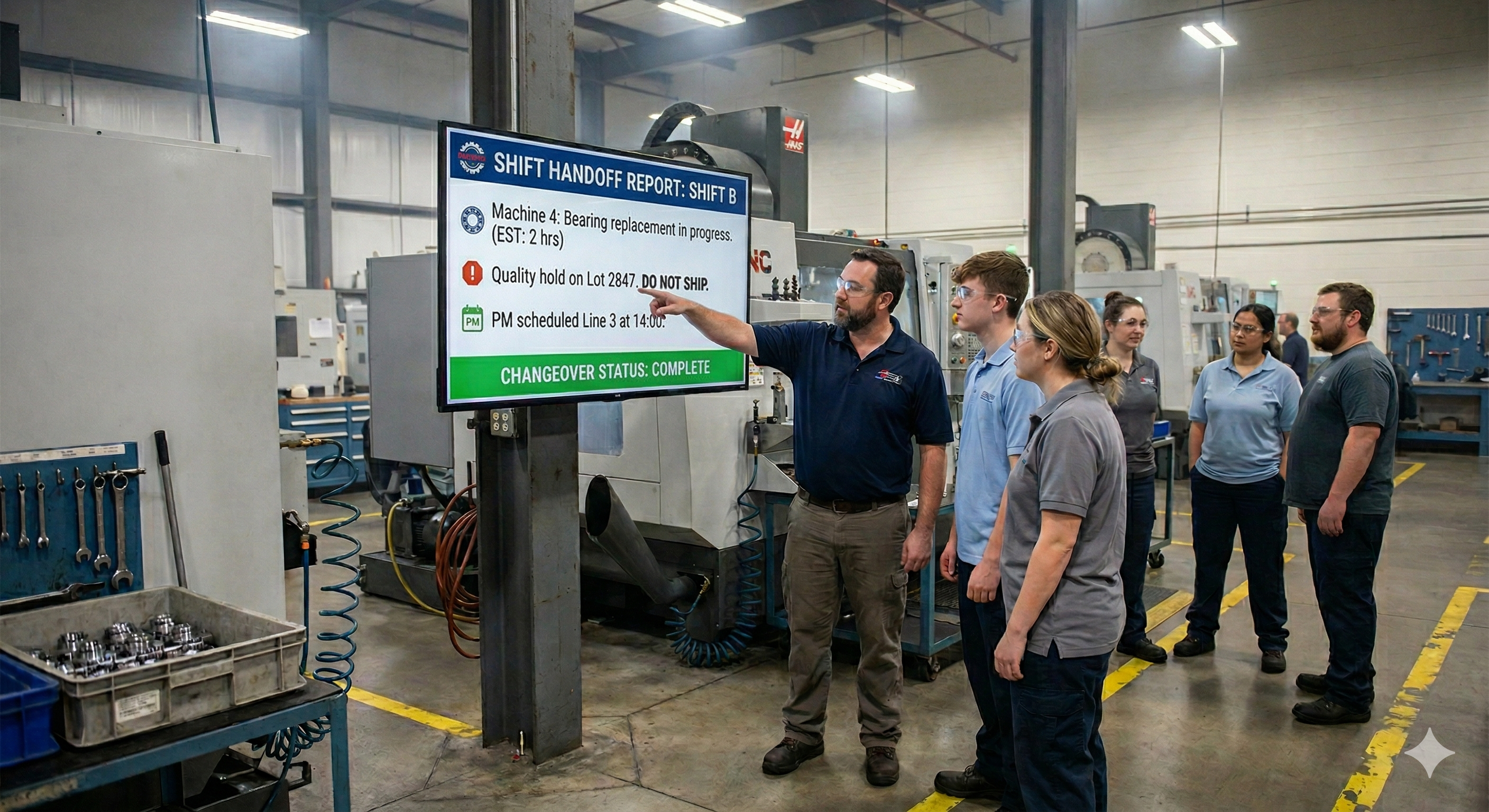
Every manufacturing plant runs on the assumption that the next shift will pick up exactly where the last one left off. In practice, that almost never happens cleanly. A supervisor leaves a note about a bearing that started running hot. An operator mentions a recipe change to whoever is standing nearby at clock-out. A maintenance tech jots something on a whiteboard that gets erased before anyone reads it. By the time the incoming crew is up to speed, thirty minutes have evaporated, and the first hour of the shift is spent chasing problems that were already solved once.
Shift handoffs account for a small slice of total operational time, yet a disproportionate share of plant incidents, quality escapes, and lost production trace back to what did or didn’t transfer between crews. The information exists. It just doesn’t survive the gap.
Digital signage is solving one of manufacturing’s oldest problems by turning shift handoff boards into persistent, always-visible communication surfaces that don’t depend on someone remembering to pass the word along.
The real cost of a weak handoff
It’s tempting to think of shift transitions as a soft problem, something that better supervision or a longer overlap period would fix. But the downstream effects are anything but soft.
When the incoming crew doesn’t know that a pressure valve was repaired overnight, they may treat a normal reading as suspicious and shut the line down for an unnecessary inspection. When a quality hold on a batch doesn’t transfer, product moves forward and has to be pulled later. When a changeover that was partially completed on one shift isn’t documented, the next crew starts over from scratch, burning time and materials.
A single missed detail during a handoff can generate hours of wasted effort, rework, or downtime. Multiply that by two or three shift changes per day across multiple lines, and the operational drag becomes significant.
There’s also a safety dimension. When an incoming operator doesn’t know that a lockout/tagout is in progress two stations down, or that a chemical addition was made to a tank that normally doesn’t receive one, the consequences can be serious. The handoff window is precisely the moment when assumptions are most dangerous and verified information is most valuable.
Why paper, whiteboards, and verbal pass-alongs fall short
Most plants have tried to formalize their handoff process at some point. The usual tools are a combination of verbal briefings, paper logbooks, and dry-erase boards mounted near the line. Each has real limitations.
Verbal handoffs depend entirely on who is talking to whom and whether the right details surface in conversation. People forget things. They summarize unevenly. They skip items they assume the next person already knows. And if a crew member is late or the overlap window is cut short, some conversations don’t happen at all.
Paper logbooks create a record, but only if someone writes in them and someone else reads what was written. Handwritten entries are often incomplete, hard to read, or buried among pages of routine notes. There’s no way to flag urgency or confirm that a specific item was seen. And paper logs can’t update themselves. If a situation changes after the entry was made, the log is already stale.
Whiteboards are fast and flexible, which is why they’re everywhere on the shop floor. But they have an obvious failure mode. Anything on that board can be erased, intentionally or not, at any time. A wipe-down that was meant to clear yesterday’s targets also removes tonight’s open maintenance note. There’s no version history, no backup, and no way to verify that the information was captured before it disappeared.
All three methods share a deeper structural weakness. They require active participation from both sides of the handoff. The outgoing crew has to remember to document everything. The incoming crew has to seek out and absorb that documentation. When the plant is running normally, this sometimes works. When things are hectic, understaffed, or abnormal, it breaks down fast.
What a digital handoff board actually looks like
A digital shift communication board replaces the whiteboard and the paper log with a screen that the entire incoming crew can see the moment they walk onto the floor. It’s not a dashboard in the traditional sense. It’s closer to a living document that summarizes everything the next shift needs to know, formatted for glanceability and mounted where people naturally look.
A well-designed handoff board typically shows several categories of information at once. Open items from the previous shift sit at the top, with each entry tagged by urgency and department. Maintenance activity is broken out separately, covering both completed work and anything still in progress. Quality holds or deviations are called out with clear visual indicators so they can’t be missed. Changeover status shows where the line stands if a product switch is underway, including which steps are complete and which still need attention. And safety notices appear in a dedicated zone that’s visually distinct from operational content.
The display rotates or pages through these sections on a schedule, so even if an operator only glances at the screen a few times during the first minutes of their shift, they’ll catch all the critical categories. Nothing depends on them opening a binder or finding the right person to ask.
What makes this approach work is persistence. The information stays on screen for a defined period. It doesn’t get erased when someone bumps the board. It doesn’t rely on one supervisor to remember every detail. And because it’s digital, it can be updated remotely if something changes between shifts or if additional context needs to be added after the outgoing crew has left.
Turning shift changes into structured communication
The transition from a whiteboard to a digital screen is more than a technology upgrade. It’s an opportunity to standardize what gets communicated at every shift change.
Most plants that struggle with handoffs don’t have a communication problem in the conventional sense. They have a consistency problem. Some supervisors are excellent at briefing the next crew. Others aren’t. Some shifts document everything. Others document nothing. The quality of the handoff depends on who is working that day, which means the plant’s operational continuity is built on individual habits rather than a system.
A digital handoff board enforces structure without adding bureaucracy. When the outgoing shift enters their notes into a system that feeds the board, they follow a template. That template ensures that key categories are always covered, even on nights when the supervisor is stretched thin or the shift was uneventful. Over time, the template itself becomes a training tool. New supervisors learn what a complete handoff looks like by filling one out, and incoming crews learn what to expect by reading a consistently formatted display.
This kind of structured communication also creates a record. Unlike a whiteboard, a digital system can log every entry, track when it was posted, and store it for review. When a quality investigation needs to reconstruct what happened during a specific shift transition, or when a continuous improvement team wants to understand whether handoff gaps correlate with production losses, that history is available.
Where to put handoff screens for maximum impact
Placement matters as much as content. A handoff board that’s mounted in the break room might get read by some people, but it won’t reach operators who go straight to the line. A screen near a supervisor’s office is useful for the supervisor but invisible to the rest of the crew.
The most effective placement is at clock-in areas and shift staging points, the physical locations where the incoming crew gathers before heading to their stations. These natural choke points guarantee that everyone passes the screen at least once, usually during the exact window when they’re mentally preparing for their shift and most receptive to new information.
Secondary screens near individual production lines can reinforce the message by showing line-specific detail. A packaging line might display changeover status and material availability, while a mixing line shows batch quality notes and ingredient lot changes. These screens serve a different purpose than the main handoff board. They provide targeted context for the people working that specific area, complementing the plant-wide summary with granular, line-level detail.
For plants with multiple buildings or distant production areas, Screenly’s remote management makes this practical. Every screen can be configured and updated from a single cloud dashboard, regardless of where it’s physically located. A plant manager can push an urgent safety update to every handoff board from their desk, or a supervisor can update a single line’s changeover notes from a tablet without walking across the floor.
How Screenly makes deployment straightforward
Getting a digital handoff board running with Screenly doesn’t require a plant-wide IT project. The setup follows the same pattern as any Screenly deployment: mount a commercial display, connect a Screenly Player, and point it at the content you want to show.
If your plant already has a web-based shift log or changeover tracker, the simplest approach is to display it directly on screen. Screenly renders any browser-based content natively, so if your handoff tool lives in a web application, it can go to the screen immediately. No reformatting, no middleware, no custom development.
Screenly’s scheduling features make it easy to rotate content on a shift-aligned schedule, so the morning crew sees the overnight summary, the afternoon crew sees the morning summary, and each display updates automatically at the right time. Because Screenly handles device management, security, and software updates behind the scenes, the ongoing maintenance burden is minimal. The plant just needs to keep the handoff content current, which is the part that actually matters.
Build connected handoff boards with Screenly Edge Apps
Off-the-shelf dashboards and simple web pages work well for many plants, but some operations need handoff boards that are tightly integrated with their existing production systems. That’s where Screenly Edge Apps become valuable.
Edge Apps is a developer framework for building custom digital signage applications with HTML, CSS, and JavaScript. These apps run directly on the Screenly Player, so they’re fast, responsive, and continue to function even if the network connection drops temporarily.
For shift handoff boards, Edge Apps open up a powerful set of integrations. Your team can connect an Edge App to your CMMS to automatically pull open work orders and display them as pending maintenance items on the handoff board. They can connect to your MES to show the current state of each production line, including which products are running, what the target counts are, and where any deviations have occurred. They can pull from a shift management system or scheduling platform to display who is assigned where, making it easier for the incoming crew to know their positions before the briefing even starts.
The real advantage is automation. Instead of requiring a supervisor to manually enter every handoff item, an Edge App can populate the board automatically from the systems where that information already lives. A completed maintenance work order in your CMMS shows up on the handoff screen within minutes. A quality hold entered in your MES appears in the quality section of the board without anyone copying it over. A changeover checklist tracked in your ERP updates in real time as each step is completed.
Edge Apps also support conditional logic. If there are no open quality holds, that section shrinks or disappears. If a critical safety alert is active, it takes priority and occupies more screen space. The board reflects the current state of the plant, not a static template. Screenly’s open-source Playground on GitHub includes Edge App examples your team can use as starting points.
Making changeover communication part of the board
Changeovers deserve special attention in any handoff system because they’re one of the most common sources of cross-shift confusion. A product changeover that starts on one shift and finishes on another creates a natural seam where information can get lost.
The typical failure looks like this. First shift begins a changeover, completes the mechanical adjustments, and documents what they’ve done on a clipboard. Second shift arrives, finds the machine in an unfamiliar state, and isn’t sure whether the changeover is done or half-finished. They either waste time verifying completed work or skip a step that was actually still pending.
A digital handoff board can display changeover checklists as a dedicated section, with each step marked as complete, in progress, or not started. When the outgoing shift updates the checklist in whatever system tracks it, the board reflects the current status immediately. The incoming crew sees exactly where things stand without having to interpret handwriting or find the right clipboard.
For plants running SMED (Single-Minute Exchange of Die) or other structured changeover programs, this visibility serves double duty. It supports the handoff itself and provides data for changeover time analysis. If the board logs when each step was marked complete, the continuous improvement team gets a timestamped record they can use to identify bottlenecks and track progress over time.
What changes when handoffs actually work
Plants that move from informal handoffs to structured, screen-based communication tend to notice the effects quickly. The first shift after deployment usually goes more smoothly than expected, simply because the incoming crew has a clear picture of what they’re walking into.
Over time, the deeper benefits emerge. Supervisors spend less time on verbal briefings because the board covers the baseline information, freeing the face-to-face conversation for nuance, judgment calls, and items that benefit from discussion rather than documentation. Operators feel more confident starting their shift because they aren’t guessing about what happened before they arrived. Maintenance teams see fewer repeat calls because the resolution from the previous shift is visible and verifiable.
There’s also a cultural shift worth noting. When handoff communication is visible to everyone, it creates accountability by default. People document more carefully when they know it will appear on a screen that the entire incoming crew reads. It’s not about surveillance. It’s about raising the floor on communication quality so that even the weakest handoff in a given week is still good enough to keep the plant running smoothly.
Ready to see if your plant is a fit?
If your shift handoffs rely on whiteboards, paper logs, or whoever happens to be standing near the time clock, there’s a faster and more reliable way. Download the free 2026-27 Digital Signage Readiness Checklist to find out what you need to put a digital handoff board on your floor and how quickly you can get there.